11.12.10

Sex And Death (and I tell a bold-faced lie)

Many species of octopuses are true romantics and mate for life. It must be, as discussed earlier, that they have three hearts.

More likely, it's that they have a tendency to die shortly after mating. There's a lot of debate on the matter, and the reasons aren't fully understood, but in a large portion of octopus species, mating is usually followed soon after by death.

Also, they don't mate for life. That bit was a lie. Even though they die not terribly long after mating, most species are not monogamous and will mate with multiple partners that are deemed 'fit' before they kick the bucket.

The most logical reason for them dying shortly after mating is that they reach sexual maturity very close to the end of their natural lifespan. Basically, that they hit puberty in September and have died of old age by New Year's. And in some species, that's probably it almost literally, since some species only live for around six months. That said, some species can live for up to five years. That's still a remarkably short lifespan for such an intelligent animal, but it's still 10x better than six months.

For the females, there's another perfectly good reason why they often die shortly after mating, or more accurately after laying their eggs. Octopus moms are fiercely devoted. They're aggressive towards anything coming near their eggs and they never leave the eggs unguarded. And they don't eat while they're guarding the eggs. Like the male emperor penguin, most female octopuses will stand guard over their eggs and slowly starve. Unlike the male emperor penguin though, the octopus doesn't have a reserve of fat which they use to make it through the time until the eggs hatch. They just flat-out starve, while their body slowly consumes itself. By the time the eggs hatch, the starved female's body is so wasted away that even if she did start eating again, she would still likely die. The thing is, they usually don't start eating again after the eggs hatch, they basically give up on eating.

Now, there's a reason that covers both of those options, and it's outlined in a 1978 paper entitled Antigen-induced secretion in the optic gland of Octopus Vulgaris (the Common Octopus), written by D. Froesch. Unfortunately, I can't find a free copy of the article online, so I'll have to hope that Wikipedia's summary is accurate. Basically, the optic glands (which doesn't seem to have anything to do with vision, unless I'm misunderstanding the abstracts of the article) controls sexual development, appetite and senescence (old age). Once the optic glands have triggered the hormones for sexual maturity, it stops sending out the normal level of appetite controlling hormones, so the female stops feeling hungry. At a set time after mating, namely a time closely connected to the time it takes for the eggs to hatch, the optic glands start releasing the hormones related to dying of old age, which causes the animal to die shortly after. If the optic glands are removed after the eggs are laid, the octopus won't die of old age, but it will still eventually starve to death.

I should point out, once more just for clarity, not all octopuses die shortly after mating, but it is a species to species thing.  It's not like the male gets off any easier than the female of any given species.  If the female dies shortly after the eggs hatch, the males generally don't survive much beyond mating.  If the male survives until another breeding season, generally the females do as well (assuming they don't get eaten while still weak after emerging from hatching the eggs).

In the world of many octopuses, like in 1980's slasher movies, having sex means you're going to die.

To lighten the mood from this sex = death, I present to you a funny little French animated short, entitled Oktapodi (2009 Oscar nominee for best animated short film).


Sources:
ScienceDaily.com article on octopus mating habits
Wikipedia article on the Octopus
TONMO.com forum thread concerning octopus death after mating
JSTOR preview of D. Froesch's article
Official site for Oktapodi

10.12.10

Blue Bloods

With the exception of the crocodile icefish (a topic for another day), all the vertebrates and a few of the invertebrates on Earth rely on hemoglobin* to transport oxygen from the lungs to the tissues that will use it.  That means that everything from fish to lizards to birds to mammals all have red blood blood when it's oxygen rich, and a blueish-purpley blood when it's oxygen depleted.  Basically, red going out from the lungs, blue coming back into it.  If you're as Caucasian and untanned as I am, you can prove that just by looking at your wrists.

Alright, the vertebrates make up about 5% of the known species, so what about the rest?  Well, most insects (which make up roughly 90% of all animals) don't really have a blood circulatory system as we'd think of it, so we'll just leave them out of this.  That pretty much leaves us with the non-insect branches of the arthropods and the molluscs.  And what did we learn were molluscs a couple of days ago?  That's right!  The sensational cephalopods!  Alright, so what do they all use for their blood if not hemoglobin?  Hemocyanin.

Hemocyanin, which sounds too much like cyanide to make me feel entirely comfortable thinking about something requiring it to live, basically uses copper atoms in place of the iron atoms in hemoglobin.  It's also a much larger molecule than hemoglobin, which means that it doesn't need to attach itself to a blood cell to keep itself from clogging the body's fine filters like the kidneys.  That means that even though cephalopods (alright, and a whole lot of other critters, but this is an unofficial Cephalopod Week) have an equivalent to hemoglobin, they don't have an equivalent to red blood cells.

Now hemocyanin, since it's a copper compound instead of an iron compound, doesn't go from blue to red when it's attached to an oxygen molecule like hemoglobin does, it goes from colourless to blue.  I couldn't find any pictures of octopus blood (and believe me, I tried), but I managed to find a whole bunch of horseshoe crab blood, which is also coloured by hemocyanin instead of hemoglobin.  Check it out:

Click to embiggen, clicky-poppy

Pretty cool, huh?

Cephalopods: The blue bloods of the seas.

Damnit, I know there are only 800 or so species of cephalopods, and over 85,000 species of other molluscs that also rely on hemocyanin, plus an unknown number of arthropods, which means they aren't really the blue bloods of the seas, but this is an unofficial Cephalopod week, so let them (and me) have that, okay?

*For the record, I prefer the British spelling, haemoglobin, but I hate that it sets off my spell-check, so I'm using the American spelling.


Sources:
PressOfAtlanticCity.com article - great picture of blue horseshoe crab blood that I couldn't hotlink to
Image taken from PSB.org article on horseshoe crab blood
HowStuffWorks.com article on the octopus body plan
Xenology.info page on non-hemoglobin-based circulatory systems - with regards to alien physiology, but with solid chemistry info nevertheless
Article from DavidDarling.info - "The Internet Encyclopedia Of Science", basically the same article as the xenology one above, but with better presentation and slightly less science
Fascinating video on horseshoe crab blood collection from Journal of Visualized Experiments - only loosely related, but interesting nonetheless
Wikipedia article on Hemocyanin
Wikipedia article on Octopuses
Wikipedia article on Red blood cells
Wikipedia article on Hemoglobin

9.12.10

I'm A Famous Artist. And I LOVE Octopuses


Before we get rolling, do you have to put a Not Safe For Work warning when the pictures in question are works of art created by some of the best known artists in history? If I do, here's your warning. Turn back now and clear your browser cache. I don't think you need to. I mean, kids are allowed to see Michelangelo's David, so why should I have to warn you when it comes to the images here? Maybe it's like one of webcomics I read says, "Porn is anything you masturbate while looking at. Your ceiling is porn." Anyways...

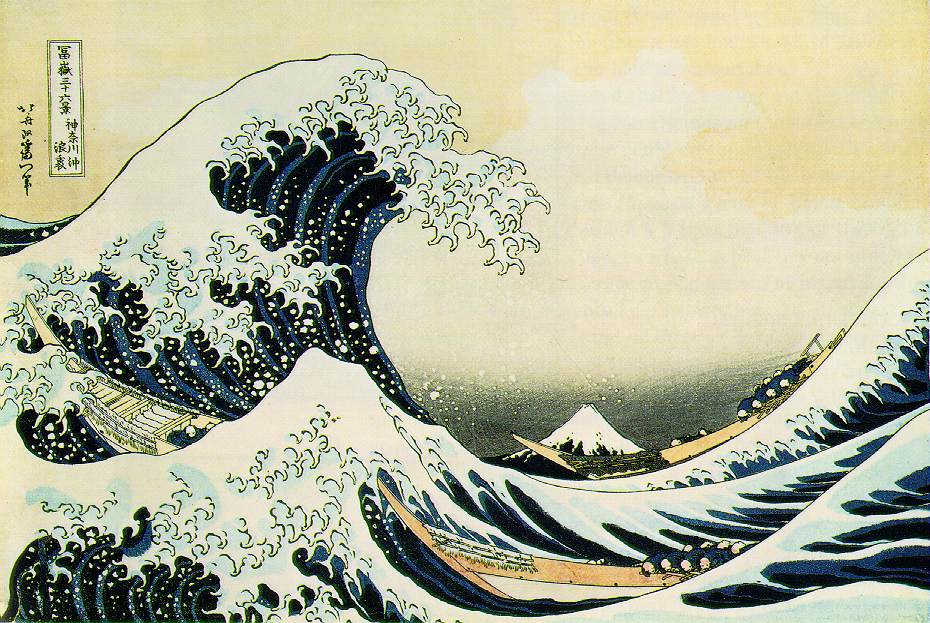
You may not know the name, but you know his work. The man is Katsushika Hokusai, and he's so famous that his name doesn't even set off my spell-check. He was an artist specializing in woodcuts (although he did use other techniques, and used them well) in Japan during the Edo period (Edo does set off the spell-check... that's funny), which ran from 1603 to 1868.  He worked from 1774, when he was 14, until he died at the age of 87.  He is probably best known for his series, "Thirty-six Views Of Mount Fuji", which due to popular demand was eventually expanded to forty-six views.  No, that's not a joke.  Even in the 1800s artists, even highly talented and respected artists, weren't above following public opinion to wherever the money was.  Alright, still having trouble picturing his work?  Let me help you out.

The Great Wave Off Kanagawa, first in the series Thirty-six Views Of Mount Fuji
(click to embiggen, clicky-poppy)

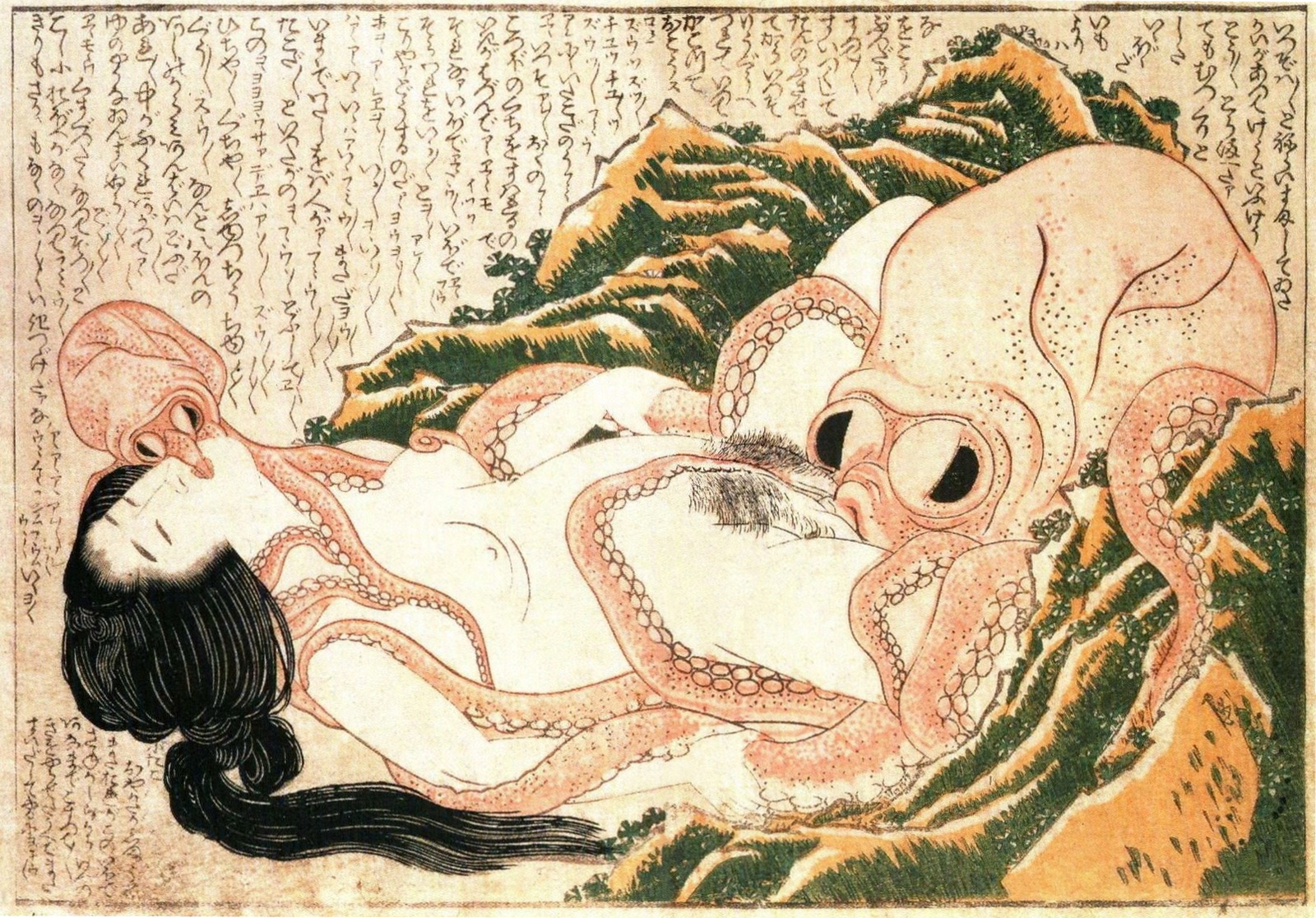
We're all on the same page now, yes?  He made perhaps the best known image in Japanese art history, and didn't just rest on his laurels.  He was incredibly prolific.  One of his other pieces is just as well known, although in a very different circle.  It's entitled The Dream of the Fisherman's Wife, and... well... even though it is a masterpiece, created by an incredibly talented artist, it is... how to say this... unusual.

The subject matter is associated with the myth of Princess Tamatori, who... you know what?  I don't really buy it.  The story of Princess Tamatori is so different from the picture that if it was a movie, it was be listed as "Inspired by".  In the story, Tamatori escapes unharmed by the dragon or its grotesque guardian creatures, but dies from a self-inflicted wound.  The Dream of the Fisherman's Wife has a woman who, shall we say, does not escape unmolested.  And I mean that in the most literal sense possible.  Perhaps it's time to finally reveal what Hokusai liked to draw when he wasn't drawing waves and distant views of mountains.

The Dream of the Fisherman's Wife
(click to embiggen, clicky-poppy)
Yes. he created the first known example of tentacle porn.  In 1814.  Some people have theorized that Japan's strangely high rate of fetishism, particularly for things like tentacle porn, have to do with the damage to the collective psyche caused by the devastating loss of WWII, particularly the destruction of entire cities by nuclear weapons.  They say that for a society to become this sexually... I hesitate to say perverse, since that's pretty judgmental... atypical, they have to be damaged goods.  Just look at Germany's association with coprophilia (whether justified or not, I have no idea) as another example of this theory in action.

But then look at the date for Hokusai's work.  1814.  That's a long time before the World Wars.  Japan has been a strange country for a long, long time.  And it's catching.  Check this out:

Untitled piece, Pablo Picasso, 1903
That's a piece done by Pablo Picasso in 1903, directly inspired by Hokusai's piece.  Perhaps needless to say, being a famous artist doesn't mean you aren't a seriously strange guy.

Hokusai: World famous artist and a big fan of octopuses.  Also an inspiration to Picasso and a whole sub-section of modern Japanese society.

And no, I'm not going to show examples of the current batch of "tentacle erotica".  You've got the internet, you can find it on your own.

Also, octopuses is the correct plural.  Octopi comes from the mistaken belief that octopus is Latin in origin, but it's Greek, so octopi is just flat-out wrong.


Sources:
Image of The Great Wave Off Kanagawa taken from WebMuseum of Paris
Image of The Dream of the Fisherman's Wife taken from Wikipedia
Image of Picasso's untitled erotic painting taken from ModelErotic.com
AK-Antiek antiques - Dutch site (in English) with some commentary and excellent pictures of The Dream of the Fisherman's Wife
Article on Japanese erotic art from St. Olaf's College in Minnesota
On-line Picasso Project
Wikipedia article on Hokusai
Wikipedia article on The Dream of the Fisherman's Wife
Wikipedia article on tentacle erotica

8.12.10

You Broke My Heart, Good Thing I Have A Couple Backups

You think the platypus is an interesting animal?  They've got nothing on the cephalopods.  The squid, octopuses, nautiluses and cuttlefish are way more interesting than any old monotreme.  I could probably do a week of octopus trivia without effort. Probably won't though.

Anyway, in an effort to keep this one relatively short and sweet, I'm going to get on with it.

The cephalopods are somewhat unusual amongst the molluscs (snails, clams, cephalopods, etc) in that its circulatory system is fully enclosed.  That means that their blood never leaves its veins and arteries (same thing with mammals like you and I), but in the rest of the group the blood goes out from the heart and lungs and basically just sloshes around.  Doesn't seem very efficient to me, but they seem to be doing fine, so I won't pressure them to change.

(click to embiggen, clicky-poppy)
Big deal, you say.  Lots of things have a closed circulatory system.  Basically, if it's not an insect or mollusc, it has a closed circulatory system.  Or none at all, in the case of flatworms, but that's a topic for another day.  Since so many things have a closed circulatory system, why am I wasting your time talking about the closed circulatory system of the octopus?  Because, like a great many things in cephalopod anatomy, even though it does the same job as what we have, it goes about it in a strange way.

Namely, cephalopods have three hearts.  Where mammals have evolved a four chambered heart, with two chambers responsible for getting de-oxygenated blood to the lungs and two chambers responsible for getting the oxygenated blood from the lungs to the rest of the body, cephalopods have developed a heart for each bit of work.  For each set of gills (there are two sets of gills, like we've got two lungs), there's a heart that pumps their blood through it.  After their blood (also fascinating, also a topic for another time) is oxygenated, it gets pumped through the body by their third heart. In the diagram above (figures A & B) the gill hearts are called Branchial Hearts and they only label one, but you can see that there's two.  The heart that pumps to the body is called the Systemic Heart (figure C).  Even though none of them are technically redundant, they can survive if one of them's not working properly, since the other two will still provide enough pressure to keep them alive.

Cephalopods: Creepy, disgusting sea beasties, with heart enough to spare.

Sources:
Image from The Octopus News Magazine Online forums, original source unknown.
Cephalove blog article on cephalopod hearts (not some gross furry fetish site, I swear, although this particular article is about mating)

7.12.10

Proof Of God's Sense Of Humour

 So please - before you think about hurting someone over this trifle of a film, remember: even God has a sense of humor. Just look at the Platypus.
-Opening credits to Kevin Smith's film Dogma.
In all fairness to the talents of God and evolution, these are some pretty hilarious and fascinating creatures.

First off, they are, despite appearances, mammals.  They're in Order (remember Linnaean taxonomy? Kingdom, Phylum, Class, Order, Family, Genus, Species) Monotremata along with just the Echidnas in Class Mammalia, and the monotremes are defined as egg-laying mammals.  All told, there are five species of monotremes, four of which are echidnas and just one species of platypus.

Secondly, they're venomous.  One of only eight species of mammals known to be venomous (nine if you count the slow loris, but I don't), and the only one that actively injects venom (the way a snake does).  The rest 'just' have venomous saliva, so their bite is venomous, but they don't technically inject it through a needle-like delivery system.  Plus, all the other species of venomous mammals are small.  Mouse to rat-sized small.  The platypus is a fairly big animal, roughly rabbit or housecat sized.  The males (and only the males) have a smallish spur on their back legs that can be used to inject a venom.  How dangerous is this venom?  It's killed dogs, and in it causes what is called "extreme pain" and swelling in people.  Nobody's ever died from a platypus sting, which is good, because nobody's figured out how to make an antivenom for it yet.

The next thing that makes them awesome is that beak of theirs.  It looks like a duck's, and while it does have bones in it, it's mostly soft and sensitive.  Better than that though, is that it's got electro-receptors in it.  Like sharks, they can detect the bioelectric field that living things put out.  They use it to track down prey, such as insects, crayfish and shrimp, because when a platypus dives, it closes not just its eyes, but also its nose and ears.  Saying it can't smell under water would be wrong, it has a secondary sense of smell that relies on vomeronasal receptors instead of olfactory receptors, and it's unusually acute (a thousand receptors compared to just hundreds for most mammals), but even without the vomeronasal senses it would still be able to find prey.  Which researchers think it has to do, since their prey can and do hide in the mud at the bottom of the ponds and rivers where it lives.

The platypus: Proof of God's sense of humour, and of the wonders of evolution (particularly convergent evolution).

One last fun fact for the road: Female platypuses (not platypi) have no nipples, just two smooth milk secreting patches of skin on their belly.


Thanks to Martin O'Halloran for pointing out both a spelling mistake and an omission regarding Linnaean taxonomy.

Sources

Image from LearnAnimals.com
Wikipedia article on venomous mammals
Australian Platypus Conservancy website
AustralianFauna.com platypus factsheet
Wikipedia article on the platypus
Protein Spotlight article on platypus venom
Cosmos magazine article on platypus venom
Cosmos magazine article on the platypus genome

6.12.10

Putting The Lady In Ladybug

 First off, this here is North America.  We call them ladybugs, not ladybirds.  Why?  Because they're not birds.

Alright, they're not technically bugs either (bug is, believe it or not, a technical term, and beetles aren't bugs), but they're a heck of a lot closer to bugs than to birds.  I guess maybe we should listen to R.E. White and just call them lady beetles, but then we wouldn't be able to sing Ladybug's Picnic.  We should be careful when in the UK though, because their choice to not call them ladybugs is kind of deliberate, since the word bug is associated pretty strongly with buggery (sodomy) there, and that's not the kind of thing one talks about in polite society.  Just a heads up if you're planning on going abroad.

One thing everyone in the English-speaking world seems to agree on though, is the "lady" bit.  But who's the lady?  The lady is the Lady.  For those not totally indoctrinated, the Lady is Mary: the Madonna (ma = my, donna = lady), Notre Dame (notre = our, dame = lady), namesake of countless Virgin Mary sightings (Our Lady Of Fatima).  It all makes sense now, doesn't it?  A small, red and black beetle is named after Mary, Mother of Christ.

Alright, that totally doesn't make any sense yet.  So here are the stories behind naming them after Mary, and they're both good and believable, which means it's probably a combination of the two.

First off, is the knowledge of the working man, in this instance, farmers.  Most ladybugs are predators, eating other insects (they've also been known to take a bite out of people when their normal food supplies gets low), and the insects they prefer are aphids and scale insects (both actual bugs, oddly enough).  Aphids and scale insects are tiny sap-drinking insects that can be extremely damaging to many crops, including barley and hops.  Barley and hops are two of four ingredients in traditional beers (the other two are water and yeast), and if you want a man to send thanks to Heaven, you'll send him something that will protect his beer supply.  "Thank Mary for sending these beetles to save our beer!"

Alright, they eat the pests off a lot more than barley and hops, but come on, that's a good story, and is true enough to pass in court.  Ladybugs eating agricultural pests is usually the cited reason for their name, and is supported by the following kid's rhyme:
Ladybird, Ladybird, Fly away home. Your house is on fire, And your children all gone.
or
Ladybird, Ladybird, fly away home! Your house is on fire, Your children do roam. Except little Ann, who sits in a pan Weaving gold laces as fast as she can.
The burning house is a reference to farmers burning their hops fields (beer!) after harvest to enrich the soil, 'little Anne' is a reference to ladybug grubs and the 'gold laces' are the shed skins as the grubs moult.

Another reason they're associated with Mary is because they seem to be divinely protected.  Very few things eat ladybugs, compared to other bugs of the same size.  Your elementary school science lessons should tell you why.  Come on, think back.  What do bright colours usually mean for animals?  That's right, they're either poisonous or they taste terrible.  Ladybugs taste terrible.  Don't believe me?  Try one when the weather warms up and they come out again.  You may not even have to eat the whole thing.  When really frightened, ladybugs have a behaviour called 'reflexive bleeding', where they release a fluid from their joints that is yellowish, foul smelling and even more foul tasting.  So this tiny, seemingly (to people, with our relatively poor sense of smell) defenseless beetle goes about its business, totally unmolested by birds and other animals, and people assumed that there was some sort of divine intervention on their behalf.  In a time when people prayed to Mary to intervene on their behalf, it's logical to assume that the beetle is being graced by Mary as well.

There's a third story, but I find it hard to believe that it arose on its own, without the name ladybug/bird already in play.  Many early paintings of Mary depicted her wearing a red cloak (where we're used to a baby-blue robe) that had black spots on it to represent, depending on the painting either the Seven Joys Of Mary, or in a complete about-face, to the seven sorrows of Our Lady Of Sorrows (another in a long litany of titles for Mary).  By some strange coincidence, the most common type of ladybug (there are over 5,000 species worldwide) in England is red with seven black spots.  Easy connection to make if you've seen a painting of her in red with black spots and you already believe them to be either sent by Heaven to protect your crops or that they're divinely protected themselves.

So there you go, the lady in ladybug is notre dame, the Madonna Mary.


Sources:

Ladybug articles from:
HowStuffWorks.com
Ladybug.com
University of Dayton (Ohio)
MuseumStuff.com
Etymonline.com - Online Etymology Dictionary
Wikipedia

Sesame Street's Ladybug Picnic on YouTube.com
Wikipedia article on The Seven Joys Of Mary
Great Big Sea singing The Seven Joys Of Mary from Christmas-tree.ca
MyCatholicTradition.com article on Our Lady Of Sorrows
Wikipedia article on the Seven Sorrows Of Mary
Wikipedia article on the Titles of Mary
Barley Pests 

5.12.10

They Were Married? That's Entertainment!

Everyone knows who Liza Minelli is, although, honestly, I'm not sure why.  She's somehow a much bigger celebrity than I can explain.  Having looked through her filmography, the only thing I've ever seen that she's been in has been Muppet related, and she was always playing herself.  Perhaps it's Cabaret she's famous for.  I dunno, I've never seen it.

Or perhaps, she's the Nicole Richie of her day.  Her mother was, after all, none other than Judy Garland of Wizard Of Oz fame.  And her father was Vincente Minelli, one of the greatest directors of the 1950s.  She's got pedigree, and I assume she has some level of talent since she won an Oscar (for Cabaret, which confirms my guess that she's famous for that role), although I admit there are some Oscar wins that are... shall we say... questionable?  Yes, I'm looking at you Denzel Washington winning for Training Day.

Anywhoo... Liza Minelli, daughter of Judy Garland, is also well known for getting married and divorced several times.  She's no Elizabeth Taylor (married 8 times, divorced 7), but she has been married, and divorced, 4 times in 40 years.  What's fun and interesting is the identity of husband #2.

Her second husband was a writer/director/producer by the name of Jack Haley Jr, whom she met while doing an introduction for Haley's film That's Entertainment!.  What makes her marriage to Jack Haley Jr. interesting?  Well, as previously mentioned, Liza is the daughter of Judy Garland, who played Dorothy in The Wizard Of Oz.  Well, Jack Haley Jr. is the son of Jack Haley (obviously), who played the farmhand Hickory in The Wizard Of Oz.  Oh, alright, he also played the Tin Man.

The daughter of Dorothy married the Tin Man's son!

Complete aside, Tin Manson sounds like an awesome name for a robotic serial killer.


Sources:
IMDB pages for
Liza Minelli
Jack Haley Jr.
The Wizard of Oz

TCM article on That's Entertainment!

4.12.10

American Girl's Last Dance

"Last dance with Mary Jane, one more time to kill the pain."

 Great song about marijuana, yeah?  Well, maybe not so much.  The original line was:
"Hey Indiana girl, go out and find the world."

Petty thought that sounded pretty weak, so he put recording the song on hold and came back a week later with the new lyrics.  Listen to the current song, but change the Mary Jane reference to another reference to an Indiana girl, and there's no reason at all to suspect it's about drugs.  I'm not saying Mary Jane isn't a drug reference, but I will say that it wasn't originally a song about drugs.

The interesting thing is, besides the fact that this song goes down with Lucy In The Sky With Diamonds as one of the all-time most drug-referenced songs not written about drugs, Tom Petty thinks there's a connection between Mary Jane's Last Dance and another song of his, American Girl.  According to an interview with Mojo Magazine in Jan 2010 (which I can't a transcript for online, so this is hearsay and may not be true), Petty says that Mary Jane from Mary Jane's Last Dance is the girl from American Girl "with a few hard knocks."


An American Girl's Last Dance?  Sounds good to me.


Sources:
Lyrics to Mary Jane's Last Dance
Songfacts.com interview with Mike Campbell, lead guitarist of Tom Petty & The Heartbreakers
Songfacts.com Mary Jane's Last Dance trivia

3.12.10

Shrimpoluminescence

 In the year 2000, scientists from the Technical University of Munich along with scientists from the University of Twente (it's in the Netherlands) discovered something fascinating while researching Pistol Shrimp.  They were examining how such a tiny animal (they're in the range of 2cm long) could make such a loud noise.  How loud?  Well, they're in the running for the loudest animal on the planet.  How loud is that?  Well, here's a handy diagram that shows various levels of volume in decibels:
It should be pointed out that instant perforation of the eardrum is generally estimated at 160dB.  Alright, so where does our little Pistol Shrimp show up in that diagram?  Well, he doesn't.  He's off that scale.  And off every other scale I could find in graphic form.  You see, there's a theoretical limit on how loud things can get in air; any louder and you technically stop getting sound and you start getting shockwaves.  That's somewhere in the neighbourhood of 194dB.

But the limit is different in water.  It is much, much higher.  Our wee little shrimpy friend creates sounds as high as 218dB.  That's loud enough to kill other animals, and has even been known to break glass jars that people are holding the shrimp in.  They do it by clicking one of their claws shut extremely quickly, which creates a cavitation bubble (think the trail of bubbles that a spinning propeller creates).  The collapse of this bubble makes a loud popping sound.  Sound is nothing but pressure waves, and so the sound of this popping bubble literally does concussive damage to the animal the shrimp aims it at (think flash-bang grenades).

Alright, very cool, but what the hell is Shrimpoluminescence you ask?  Well, it turns out that the collapse of this cavitation bubble produces not just sound, but light and heat as well.  A lot of heat.  Almost as hot as the surface of the Sun hot.  It's only a very small amount that quickly dissipates into the surrounding water, but at the center of it, in a very tiny area, the temperature is over 4,700°C.  There's not much light though, it's not visible to the naked eye, but it does exist.  It's technically called sonoluminescence (light formed by imploding bubbles that are formed by sound), but honestly, isn't Shrimpoluminescence much more interesting?


That clicking sound you hear? That's the sound of evolution being awesome.


Sources
Decibel level image
Wikipedia article on sound pressure (dB)
University of Twente - official, outdated website for the researchers who discovered shrimpoluninescence
Fun article on pistol shrimp
Daily Mail article on pistol shrimp
Wikipedia article on sonoluminescence

2.12.10

The Crushing Depths

For every 10m you go under water, the pressure on your body goes up an amount equal to what we experience on land at sea level.  So if you're 20m below the water's surface, there's three times as much pressure on your chest as you're used to.

And the ocean goes deeper than 20m.  A lot deeper.  The average depth of the ocean is estimated to be around 3,800m.  The deepest point is 11,034m below the surface.

Using the basic math outlined above, that's 1,103x more pressure you're used to.  That's about 1,150kgs per centimetre².  To put that into perspective, a centimetre² is about the size of a fingernail, and 1,150kgs would be an unusually large Clydesdale horse.

Given a chest area of 40cm x 70cm, that's 2,800cm².  Which means you've got over 3,000,000kgs of pressure on your chest.  Or 3,000tonnes.  Large horses aren't a useful measurement here, so let's go bigger. A large blue whale could weigh as much as 150tonnes, so that's 20 (large) blue whales.  Man, even that's hard to picture.  What can I find that's equal to 3,000tonnes?

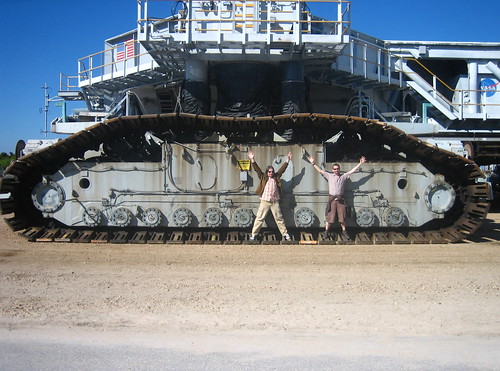
Well, I couldn't find anything in a quick search, but I did find NASA's Crawler Transporter, which clocks in at 2,700tonnes, which is reasonably close and totally illustrative.  It's the world's largest self-powered land-based vehicle (beaten by both vehicles not self-powered and by sea-based vehicles in terms of size).

Here's a picture of two people standing on one of the Crawler's treads, to put those in perspective:

Now, here's a picture of the full Crawler:
(click to embiggen)

And here it is, doing what it's built to do:
(click to embiggen)

So, if you somehow find yourself at the very deepest depths of the ocean, it would feel a lot like having the vehicle that moves the space shuttle (and the launch platform at the same time) sitting on your chest.


Sources
Wikiepedia entry on cm²
Marinebio.org ocean facts
Discover Magazine article on deep sea animals
International Society for Photogrammetry and Remote Sensing article about... not sure, but it gave surface area for a chest
American Cetacean Society Blue Whale Fact Sheet
Wikipedia article on Clydesdale horses 
Adactio's flicker account
Wikipedia article on the Crawler Transporter