Alright, we learned yesterday that we, as a whole, will cave to authority pretty easily. But what happens when the position of authority is just in our heads? When the authority is totally arbitrary and not based on anything other than random chance?
If you've heard of the Stanford Prison Experiment, you already know the answer and you can go read an article on Cracked.com or something else if you want. Try this one about animal intelligence, it's pretty fascinating.

12.1.11
I'm Testing The Effect Of Negative Reinforcement On ESP
Alright, this isn't about ESP, but it is about electrical shocks and negative reinforcement. The title is a Ghostbusters reference, which is, in turn, a reference to today's topic: The Milgram Experiment.
Also, this fact isn't particularly fun except for the fact that it's a great conversation topic. But since that's kind of how this blog started, it's what we're talking about today.
The 1960s and early 1970s were a wonderful time to be an experimental psychologist, in that a lot of laws regarding ethical experimentation were only made in reaction to some of these experiments. In addition to the Milgram experiment, there was also the Stanford Prison experiment (I plan to cover it tomorrow) and the end stages of the CIA's MKULTRA experiments into LSD. Basically, you could get away with almost anything, which made for some interesting research. Unethical by modern standards, but totally interesting nonetheless.
Also, this fact isn't particularly fun except for the fact that it's a great conversation topic. But since that's kind of how this blog started, it's what we're talking about today.
The 1960s and early 1970s were a wonderful time to be an experimental psychologist, in that a lot of laws regarding ethical experimentation were only made in reaction to some of these experiments. In addition to the Milgram experiment, there was also the Stanford Prison experiment (I plan to cover it tomorrow) and the end stages of the CIA's MKULTRA experiments into LSD. Basically, you could get away with almost anything, which made for some interesting research. Unethical by modern standards, but totally interesting nonetheless.
10.1.11
The Beekeeper's Keep Will Keep
When I was a kid, my grandfather supplemented his retirement funds by being a beekeeper. The technical term for a beekeeper is an apiarist, but beekeeper's much more to the point. So needless to say, honey's been a part of my life for as long as I can remember. When I'd get burns as a child, the burn would be covered in honey. My grandmother used to sing to me, "Honey in the morning, honey in the evening, honey at suppertime. Won't you be my honey, and love me all the time?" I'd have peanut butter and honey on my toast. My life was infused with honey. Honey has a place in my heart now, and it will forever.
So I guess it's a good thing that honey will never go bad.
Alright, it's not entirely true that honey won't go bad, but it can be. Basically, honey is fairly acidic (somewhere between orange juice and a tomato), very high in sugar, and it traps moisture easily. Those three factors mean that honey, if it's in a container that doesn't allow moisture to enter it, doesn't support any bacterial growth since either the acidity, the high sugar, or the lack of water will keep any bacteria from surviving in it. If it's not in a moisture-proof container, the honey will eventually absorb enough moisture for it to dilute enough for things to grow in it. Usually this will result in the honey fermenting (ya alcohol!), sometimes it will end up being much more dangerous, but properly sealed? It will keep pretty much forever.
It is said (although I cannot find a copy of the original source, although I know it's attributed to archaeologist Theodore M. Davis and the Sept. 1913 issues of National Geographic) that some honey found in Egyptian tombs is still edible, after roughly 3,300 years. I personally still have a container of perfectly edible honey from my grandfather's hives, and he's been dead for over a decade, and he retired from beekeeping years before that.
That's not saying that all honey is safe. I mean, just because nothing dangerous will grow in it, that doesn't mean that there's nothing dangerous in it to start with.
First off, there's a good chance that there are spores from the bacteria that cause botulism in honey, and while there's not enough of them to be dangerous to an adult (we tend to digest the spores) they can be dangerous for very small children, so honey shouldn't be given to kids under a year old.
Secondly, bees sometimes get their pollen and nectar from plants which are toxic to people but that have no effect on the bees. Honey made from nectar from the common rhododendron, for instance, can cause both delirium and vomiting. A whole host of plants can give rise to toxic honey, with symptoms varying from excessive perspiration and dizziness to paralysis and death, with a whole host of possibilities in between. In fact, it's said that honey made from hives where opium poppies are common is narcotic.
Commercially farmed honey is rarely toxic because the honey comes from enough sources that any toxic components are only present in trace amounts, and in general it's a problem more associated with wild hives.
Properly stored honey: As good as the day it was put away.
Sources:
Image of the Honey movie poster taken from Online-movies-free.com - I in no way use or endorse this site, it's just where I took the image from
Mead bottle image taken from Bunratty Winery
Honey-Health.com
Canadian Honey Council
National Honey Board of America
Wikipedia articles on honey and bees and toxic chemicals
So I guess it's a good thing that honey will never go bad.
 |
| Assuming the honey was good to start with, that is. |
 |
| What deliberately fermented honey looks like. |
It is said (although I cannot find a copy of the original source, although I know it's attributed to archaeologist Theodore M. Davis and the Sept. 1913 issues of National Geographic) that some honey found in Egyptian tombs is still edible, after roughly 3,300 years. I personally still have a container of perfectly edible honey from my grandfather's hives, and he's been dead for over a decade, and he retired from beekeeping years before that.
That's not saying that all honey is safe. I mean, just because nothing dangerous will grow in it, that doesn't mean that there's nothing dangerous in it to start with.
First off, there's a good chance that there are spores from the bacteria that cause botulism in honey, and while there's not enough of them to be dangerous to an adult (we tend to digest the spores) they can be dangerous for very small children, so honey shouldn't be given to kids under a year old.
Secondly, bees sometimes get their pollen and nectar from plants which are toxic to people but that have no effect on the bees. Honey made from nectar from the common rhododendron, for instance, can cause both delirium and vomiting. A whole host of plants can give rise to toxic honey, with symptoms varying from excessive perspiration and dizziness to paralysis and death, with a whole host of possibilities in between. In fact, it's said that honey made from hives where opium poppies are common is narcotic.
Commercially farmed honey is rarely toxic because the honey comes from enough sources that any toxic components are only present in trace amounts, and in general it's a problem more associated with wild hives.
Properly stored honey: As good as the day it was put away.
Sources:
Image of the Honey movie poster taken from Online-movies-free.com - I in no way use or endorse this site, it's just where I took the image from
Mead bottle image taken from Bunratty Winery
Honey-Health.com
Canadian Honey Council
National Honey Board of America
Wikipedia articles on honey and bees and toxic chemicals
8.1.11
I'd Name Him Redenbacher.
Click play and listen to this while you read.
It'll add to the experience. I promise.
So. Bearcats. What exactly is a bearcat? Well, if you look at the cat evolutionary tree I linked to yesterday, it would be somewhere near the bottom of the image with the linsang, the civets and the genets, so it is related to cats. It's in the Suborder of Carnivora called Feliformia, while means cat-like. It's not actually part of Family Felinae (it's from Family Viverridae), so it's not technically a cat, but it is catlike. It's also a burly omnivore, which is a pretty bear-like thing to be, hence the name bearcat. Its proper name is Binturong though. And it looks like this:
 |
| Anyone else think there's a bit of a resemblance to Salacious B. Crumb? No? Just me? Oh well. |
They laugh. Or at least, they make a chuckling sound when they're happy. I'd love to throw a link here for you to listen to a chuckling bearcat, but I can't find one. Hell, I even tracked down the episode of Dirty Jobs where they met a bearcat, and no chuckling there either. If Mike Rowe can't get footage of a happy bearcat, nobody can.
Their massive tail? It's prehensile. They are, in fact, one of only two 'carnivorous' animals with a prehensile tail, and arguably the largest animal on the planet with a prehensile tail. Carnivorous is in quotes there because even though they are capable of catching, killing and eating almost anything smaller than they are, they eat mostly fruit.
They are capable of embryonic diapause, which means they're capable of delaying fetal development for up to a year after becoming pregnant. This lets them time the birth of their litter (up to six) to a time when things are looking good, whether that's Spring, Summer, Autumn or Winter. There's only around 100 species of mammals that can do it, and the bearcat's one of them.
They are capable of turning their ankles backwards so that their claws can still grip into trees as they climb down face-first.
Lastly, and bestly in my opinion, is their musk glands. When you hear musk, it's not generally a good thing. Think sweat, think cat piss, think skunks. None of those are particularly pleasant. And then along comes the binturong and its musk glands. What does binturong musk smell like? Buttered popcorn. Or cornbread, depending on who you ask. Either way, it smalls buttery and delicious. Their largely fruit-based diet, along with their buttery-corn musk, makes their poop smell (according to some, not according to Mike Rowe) like Frito corn chips.
While I'm fairly certain that it's not legal to own one as a pet anywhere in North America, they are sometimes kept as pets in Malaysia. Which means they can be at least partly domesticated. Which means I want myself a biggish, burly, buttery beast for myself.
The binturong: Cat-like, bear-like, and deliciously buttery scented.
Sources:
Binturong image taken from the East Timor National Zoo
Wikipedia
San Diego zoo
Honolulu zoo
TheAnimalFiles.com
Various YouTube videos linked above
7.1.11
I'd Name Him Wan Li
I'm allergic to cats, to the point that I'm almost willing to say I'm deathly allergic to them. That doesn't mean that I don't think they're very cool. At the very least they've got that whole aloof predator thing going. Plus, cat's have those wicked slit pupils. Cat's wouldn't be nearly as cool if their eyes didn't form slits when they contracted would they? I mean, try and picture a cat that had tiny round pupils in bright light. They'd lose a lot of mystique.
Alright, so not all cats have slitted pupils. As a generalized statement, animals within the feline family are more likely to have slitted pupils if they're small, and the larger ones tend to have round pupils like people do. The lynx, which is something of a mid-sized feline has pupils that aren't round, but aren't quite slits either.
 The reason for slitted pupils is that they reduce chromatic aberration, which is breaking the light into its spectrum colours. You'll see it a lot with crappy digital cameras. It's sometimes called fringing, because it leaves fringes of colour along the edges of things, with the fringe getting wider near the edges of the image. It caused by light refracting at different amounts at different wavelengths, and it's more pronounced when put through a rounded lens (like your eye). The slitted pupil doesn't eliminate the problem entirely, but it does go a long way.
What's interesting about this is that there doesn't seem to be any logic to why the large cats have round pupils while the small cats have slitted pupils. One could argue that it has to do with diurnal (daytime) or nocturnal hunting habits, with the nocturnal hunters having slits so they can protect their sensitive eyes during the day (slit pupils can close completely, round pupils can't), but it doesn't hold up fully. Size seems to be a bigger factor than hunting times.
Even the currently accepted evolutionary tree for cats doesn't help here. Yes, it splits the panthera genus from the smaller cats very early on, which would explain the pupil thing there, but then we've got ocelots (small, slit pupils) further removed from the modern house-cat than the puma (large, round pupils). Servals (small, slit pupils) are further removed than cheetahs (large, round pupils). There are exceptions to the small = slits; large = round rule though (isn't there always an exception?), but it's still the best general rule for pupil shape we've got for felines.
Cat eyes: Beautifully designed, arbitrarily assigned based on size.
That's it for the fun fact of the day, but feel free to keep reading, since I kept writing.
My personal favourite exception to the small = slit pupil rule? The Pallas's cat. It's about the size of a house-cat, although the thick fur makes it look quite a bit bigger, it has round pupils, and short legs for a feline. I would totally get one as a pet if I wasn't nearly deathly allergic to cats.
And if they weren't borderline endangered.
They have a few things stacked against them in the survival game, the first being that they've got great fur. Until humans came around and started wearing the skins of other animals to stay warm, that was an advantage. Now, it's a liability. Better to be ugly with no usable parts than be warm and fuzzy. Particularly if your habitat includes places that still use powdered tiger penis as folk medicine.
Another big problem for our short-legged pal the Pallas's cat is that it eats agricultural pests. That means that people don't hunt them for their fur nearly as much as they used to, because they're useful. Unfortunately, they're not so good at their job as pest control that the farmers have stopped poisoning the pests. A dead pika (rock rabbits, not to be mistaken for a pikachu, the electric mouse) is a much easier meal for a Pallas's cat than a live one. Unfortunately, they're usually dead because they ate poison. Which means the Pallas's cat is poisoned by eating the dead pika. And good luck convincing a farmer to stop laying out the poison that's saving his food supply from pests just so that a wild cat won't die.
Also going against the poor round-eyed Pallas's cat is the fact that it's pretty isolated. Again, a benefit before people starting hunting them (still something of a benefit in that regard as well), but now it's actually working against them. Their isolation from, well, pretty much everything has meant that their immune system is almost laughable (it would be if it didn't mean these awesome cats were dieing). Captive breeding programs have met with limited success because captive animals have a nasty tendency of dropping dead from infections that most other animals would survive, or wouldn't even noticeably contract.
Pallas's cats: A cool little cat with big-cat round pupils.
Sources:
Tiger eye image taken from Crystal Springs High School, Mississippi
Chromatic aberration sample image taken from TLC-Systems.com
Pallas cat image taken from ShawnOlson.net
Cat pupil shapes courtesy of dozens of Google image searches
PubMed abstract on pupil shapes and lens optics in terrestrial vertebrate eyes
AllExperts.com article on feline pupil shapes
Niches blog on feline evolution
National Geographic article on feline evolution
Wikipedia articles on Family Felidae, Genus Panthera, cats, chromatic aberration and Pallus's cat
 |
| Oh. Hey there kitty. |
What's interesting about this is that there doesn't seem to be any logic to why the large cats have round pupils while the small cats have slitted pupils. One could argue that it has to do with diurnal (daytime) or nocturnal hunting habits, with the nocturnal hunters having slits so they can protect their sensitive eyes during the day (slit pupils can close completely, round pupils can't), but it doesn't hold up fully. Size seems to be a bigger factor than hunting times.
Even the currently accepted evolutionary tree for cats doesn't help here. Yes, it splits the panthera genus from the smaller cats very early on, which would explain the pupil thing there, but then we've got ocelots (small, slit pupils) further removed from the modern house-cat than the puma (large, round pupils). Servals (small, slit pupils) are further removed than cheetahs (large, round pupils). There are exceptions to the small = slits; large = round rule though (isn't there always an exception?), but it's still the best general rule for pupil shape we've got for felines.
Cat eyes: Beautifully designed, arbitrarily assigned based on size.
That's it for the fun fact of the day, but feel free to keep reading, since I kept writing.
My personal favourite exception to the small = slit pupil rule? The Pallas's cat. It's about the size of a house-cat, although the thick fur makes it look quite a bit bigger, it has round pupils, and short legs for a feline. I would totally get one as a pet if I wasn't nearly deathly allergic to cats.
And if they weren't borderline endangered.
They have a few things stacked against them in the survival game, the first being that they've got great fur. Until humans came around and started wearing the skins of other animals to stay warm, that was an advantage. Now, it's a liability. Better to be ugly with no usable parts than be warm and fuzzy. Particularly if your habitat includes places that still use powdered tiger penis as folk medicine.
 |
| Hunted for his fur. With good reason. |
Also going against the poor round-eyed Pallas's cat is the fact that it's pretty isolated. Again, a benefit before people starting hunting them (still something of a benefit in that regard as well), but now it's actually working against them. Their isolation from, well, pretty much everything has meant that their immune system is almost laughable (it would be if it didn't mean these awesome cats were dieing). Captive breeding programs have met with limited success because captive animals have a nasty tendency of dropping dead from infections that most other animals would survive, or wouldn't even noticeably contract.
Pallas's cats: A cool little cat with big-cat round pupils.
Sources:
Tiger eye image taken from Crystal Springs High School, Mississippi
Chromatic aberration sample image taken from TLC-Systems.com
Pallas cat image taken from ShawnOlson.net
Cat pupil shapes courtesy of dozens of Google image searches
PubMed abstract on pupil shapes and lens optics in terrestrial vertebrate eyes
AllExperts.com article on feline pupil shapes
Niches blog on feline evolution
National Geographic article on feline evolution
Wikipedia articles on Family Felidae, Genus Panthera, cats, chromatic aberration and Pallus's cat
6.1.11
It's A Mouthful
Remember when I said that I was "perfectly okay being a freak in many other regards"? Today, I introduce you to one of the ways in which I'm a freak, and the physical manifestation of it.
I suffer from bruxism, and as a result I have exostotic mandibular tori.
...
Alright, that's a lot of medical terminology, and today's fun fact is (like the one about the popliteal fossa) about telling you the proper names for things you didn't know the names of. In this particular case, you may not even know that they exist. So let's break this down into simpler, smaller, bite-sized nuggets, shall we?
Bruxism is grinding your teeth or clenching your jaws, either while awake or asleep, and I've had a great deal of difficulty in finding stats for its prevalence. It's cited as one of the most common dental problems in the developed world, and it's also listed as one of the most common sleep disorders. Either way, about 33% of children do it regularly but most grow out of it. Depending on the study, between 5% and 85% of people are bruxers (yes, that's the proper word for someone with bruxism), while the majority report somewhere in the 10% range are chronic bruxers. About 5% of the population suffers from bruxism to a degree that they need treatment for their symptoms (usually headaches, jaw pain or tooth damage). I personally am not a tooth grinder, but a jaw clencher, both while awake and in my sleep.
Exostotic is the adjective (modifies a noun, if you forget your grammatical definitions) form of exostosis, which itself means bony outgrowth (ex = out, ostosis = bone growth). This is as opposed to an osteoma, which is a benign bone tumor.
Which brings us to the strangest of the odd medical terms I threw around up there: Mandibular tori. That's a plural of mandibular torus, in case you're wondering. Mandibular is, obviously, associated with the mandible, or jawbone. A torus, if you remember back to your geometry lessons, is a doughnut shape. In anatomy it refers to a rounded ridge, because it looks like the edge of a torus. Anatomically, it doesn't need to be a complete torus, just shaped like part of a torus. A mandibular torus is a bony outgrowth on the curved inner part of your mandible.
An exostotic mandibular torus is a bony outgrowth caused by damage to the jaw, usually through stressing the bone through prolonged pressure. The kind of pressure that one exerts when they clench their jaws. Exostotic mandibular tori usually form in roughly symmetrical growths on both sides of the mandible, while mandibular tori formed by osteomata rarely form symmetrically.
Normally, at this point, I'd throw a picture at you, but pictures of the insides of someone's mouth, even when it's perfect, aren't super pleasant. And pictures of a perfect mouth are pretty much unknown on the internet. All you get are the freak cases. So I will, instead, give you a CT scan, which aren't nearly as gross. Feel free to search for mandibular tori on your own if you want to look at the inside of freak mouths.
Not everyone who grinds or clenches their teeth get mandibular tori, and not everyone with mandibular tori clench or grind their teeth, but there is a strong connection between the two. There seems to be some sort of genetic predisposition, but it's unclear whether the genetic element plays more into the likelihood of being a bruxer or of forming exostoses. What is clear is that roughly 10% of the North American population has them, with no significant variance between whites or blacks, and only a minor difference between men (more likely) and women. Worldwide the prevalence varies between 5% and 40%, with the higher numbers coming from Asian and Inuit populations.
The reason that it's not considered strictly a genetic condition despite the large racial disparities is this: The can grow and shrink over time. For some people something as simple as wearing a mouthguard while sleeping is enough to make the tori slowly disappear due to reduced stress on the jaw. Clearly it's sometimes caused by environmental factors, but the high rates amongst the Inuit point towards a genetic predisposition as well. Since mandibular tori are almost always totally benign and rarely cause problems until you need dentures (at which point they pretty much just get in the way) there's not a great deal of research on what causes them. Bigger fish to fry, as it were.
They can be surgically removed but, like the appendix, there's not a whole lot of reason to do it as a preventative measure. Particularly since they can grow back. The most common problem with them (other than the denture thing) is cutting the skin covering them on sharp food like chips. Sometimes they can become so large that they interfere with swallowing and moving the tongue though, in which case medical attention is probably a good idea.
Exostotic mandibular tori: A mouthful of words for a mouthful of bone.
Sources:
Mandibular tori CT scan image taken from Radiopaedia.org
Studio Dentaire article on bruxism
Bio-medical.com article on bruxism
Soft Dental dental services
Anesthesia-Analgesia.org article on mandibular tori - PDF
Wikipedia entries on bruxism and mandibular tori
Dictionary.com pages for bruxism, exostosis, torus and osteoma
I suffer from bruxism, and as a result I have exostotic mandibular tori.
...
Alright, that's a lot of medical terminology, and today's fun fact is (like the one about the popliteal fossa) about telling you the proper names for things you didn't know the names of. In this particular case, you may not even know that they exist. So let's break this down into simpler, smaller, bite-sized nuggets, shall we?
Bruxism is grinding your teeth or clenching your jaws, either while awake or asleep, and I've had a great deal of difficulty in finding stats for its prevalence. It's cited as one of the most common dental problems in the developed world, and it's also listed as one of the most common sleep disorders. Either way, about 33% of children do it regularly but most grow out of it. Depending on the study, between 5% and 85% of people are bruxers (yes, that's the proper word for someone with bruxism), while the majority report somewhere in the 10% range are chronic bruxers. About 5% of the population suffers from bruxism to a degree that they need treatment for their symptoms (usually headaches, jaw pain or tooth damage). I personally am not a tooth grinder, but a jaw clencher, both while awake and in my sleep.
Exostotic is the adjective (modifies a noun, if you forget your grammatical definitions) form of exostosis, which itself means bony outgrowth (ex = out, ostosis = bone growth). This is as opposed to an osteoma, which is a benign bone tumor.
Which brings us to the strangest of the odd medical terms I threw around up there: Mandibular tori. That's a plural of mandibular torus, in case you're wondering. Mandibular is, obviously, associated with the mandible, or jawbone. A torus, if you remember back to your geometry lessons, is a doughnut shape. In anatomy it refers to a rounded ridge, because it looks like the edge of a torus. Anatomically, it doesn't need to be a complete torus, just shaped like part of a torus. A mandibular torus is a bony outgrowth on the curved inner part of your mandible.
An exostotic mandibular torus is a bony outgrowth caused by damage to the jaw, usually through stressing the bone through prolonged pressure. The kind of pressure that one exerts when they clench their jaws. Exostotic mandibular tori usually form in roughly symmetrical growths on both sides of the mandible, while mandibular tori formed by osteomata rarely form symmetrically.
Normally, at this point, I'd throw a picture at you, but pictures of the insides of someone's mouth, even when it's perfect, aren't super pleasant. And pictures of a perfect mouth are pretty much unknown on the internet. All you get are the freak cases. So I will, instead, give you a CT scan, which aren't nearly as gross. Feel free to search for mandibular tori on your own if you want to look at the inside of freak mouths.
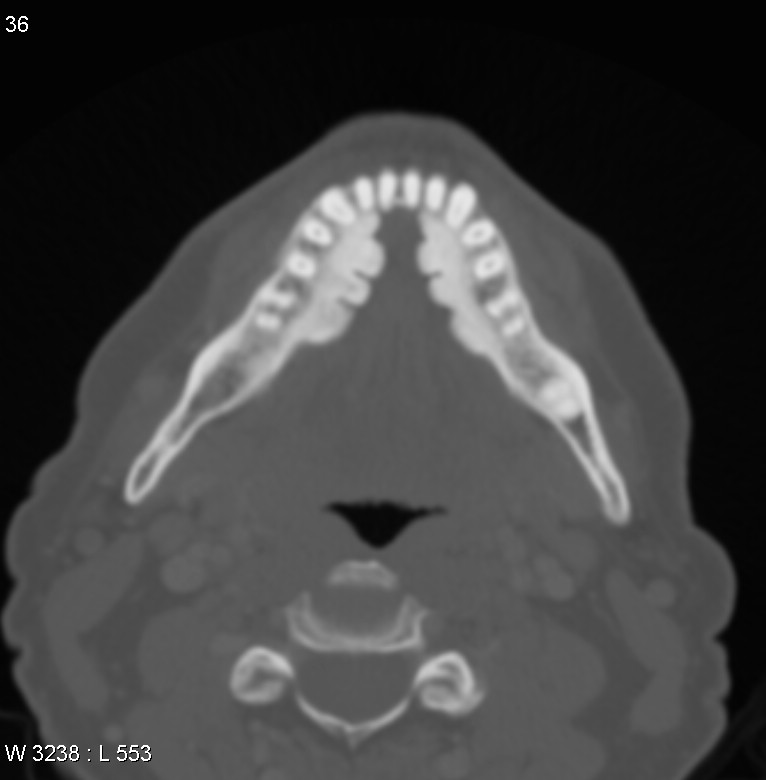 |
| Those eight lumps on the interior of the jaw? Signs of a bruxer. |
Not everyone who grinds or clenches their teeth get mandibular tori, and not everyone with mandibular tori clench or grind their teeth, but there is a strong connection between the two. There seems to be some sort of genetic predisposition, but it's unclear whether the genetic element plays more into the likelihood of being a bruxer or of forming exostoses. What is clear is that roughly 10% of the North American population has them, with no significant variance between whites or blacks, and only a minor difference between men (more likely) and women. Worldwide the prevalence varies between 5% and 40%, with the higher numbers coming from Asian and Inuit populations.
The reason that it's not considered strictly a genetic condition despite the large racial disparities is this: The can grow and shrink over time. For some people something as simple as wearing a mouthguard while sleeping is enough to make the tori slowly disappear due to reduced stress on the jaw. Clearly it's sometimes caused by environmental factors, but the high rates amongst the Inuit point towards a genetic predisposition as well. Since mandibular tori are almost always totally benign and rarely cause problems until you need dentures (at which point they pretty much just get in the way) there's not a great deal of research on what causes them. Bigger fish to fry, as it were.
They can be surgically removed but, like the appendix, there's not a whole lot of reason to do it as a preventative measure. Particularly since they can grow back. The most common problem with them (other than the denture thing) is cutting the skin covering them on sharp food like chips. Sometimes they can become so large that they interfere with swallowing and moving the tongue though, in which case medical attention is probably a good idea.
Exostotic mandibular tori: A mouthful of words for a mouthful of bone.
Sources:
Mandibular tori CT scan image taken from Radiopaedia.org
Studio Dentaire article on bruxism
Bio-medical.com article on bruxism
Soft Dental dental services
Anesthesia-Analgesia.org article on mandibular tori - PDF
Wikipedia entries on bruxism and mandibular tori
Dictionary.com pages for bruxism, exostosis, torus and osteoma
4.1.11
Welsh Watchers, An Ineffective Diet
It's not very often that people who get called out on their lies end up dead because of it, particularly if they could avoid dying by just admitting that they lied. But it does happen. Today, we learn about just such an instance. I present to you the strange case of Sarah Jacob.
Sarah Jacob was, by all accounts, a plump Welsh girl of strong morals and strong religious faith living in the mid 1800's. She also didn't eat from the age of twelve without any serious harm for almost a year and a half. Or so she claimed.
One day when she was around 11 years old, she started to vomit blood for no reason that anyone could figure out. Even though that came to an end fairly quickly, she was bedridden from then on. And the very sight of food from then on is said to have caused "very strong fits". For the next sixteen months her parents viewed her, and her survival despite not eating, as a miracle. They told the local vicar, one Reverend Jones, who despite initial doubts became convinced that the girl was a miracle and told the world.
The world pretty much laughed in his face and then tried to ignore him. So he set up nurses to watch the girl. To quote the British Medical Journal:
It was a little harder for the medical community to ignore this apparent medical mystery now that a doctor had written about it to the media, and now that everyone on the street knew about it, so a proper test of whether Sarah was actually fasting or not was set up in 1869. She would be carefully monitored for two weeks. They set up guards, day and night. They searched her bed. They checked everyone coming into the room for food or water. They were going to make sure that Sarah didn't get anything to eat or drink without their knowing it.
Now, they weren't psychopathic about it. They didn't want her to die. She could eat or drink whatever she wanted, but if she wanted it, they wanted it on record. Nurses offered her food and water, but she turned them down every time. Her health started to decline, and the Reverend Jones asked the parents to stop the whole thing, but the parents refused, saying that they had seen this kind of decline in her health before. As long as Sarah didn't eat anything, she'd get better.
Yes, they actually thought that she'd get better if she didn't eat. Let me clarify, she'd get better only if she didn't eat.
 On the eighth day of the fast, to the surprise of nobody except her parents (and presumably herself), Sarah Jacob died.
There was almost as much controversy over her death as there was over the last year and a half of her life. Because she was, even up to her death, described as a plump girl. There was an inquest into the cause of death, since how do you stay plump while starving to death? Well, in a case of acute starvation the body can't actually break down the fats in your body quick enough to stave off starvation. You'll get thinner, sure, but you can die of starvation long before you look like you're starving to death. This inability of the body to break down fat at will is also the reason that a good physical trainer will advise against losing more than a kilo a week; you're not actually losing fat, you're burning muscle. It's only with chronic starvation that you really start to get that emaciated, anorexic look. (quick side note: anorexia nervosa was formally named in 1873, totally unrelated to Sarah Jacob though)
The vicar, the doctors and the parents were all investigated in the death, but in the end only the parents were charged. They were both convicted and sentenced; her father was given a one year sentence of hard labour, but her mother was given leniency because she was pregnant. She only had a six month sentence of picking oakum (pulling apart rope and cordage into fibers). Just so you know, that's sarcasm. Picking oakum seems like a pretty hellish thing to have to do for six months, although I have little doubt that it's still better than hard labour.
It's thought that Sarah's parents honestly thought she was a miracle fasting girl, which makes the entire thing tragic for them. It's thought that one of her sisters was sneaking food in for Sarah to eat before, but they couldn't do that with the tight supervision of the test. So, there's no way that Sarah herself thought she was a miracle fasting girl, which means that she literally starved herself to death rather than admit that she was lying. That's what you call committing yourself to the lie. When you have people all around you saying, "Listen, we know you're lying. Your lie is literally killing you. Just have a sandwich and we can all go home," and you still choose to die, that's a special kind of crazy.
Sarah Jacob: Died of starvation to keep a lie going. And adding insult to injury, she was still getting called plump.
Yes, I'm aware that plump wasn't an insult.
Sources:
Evan and Hannah Jacob photo taken from the Camarthen Gaol felons register
Police news image taken from the BBC
British Medical Journal Volume 2, 1869 edition
The Lancet, Volume 2, 1870 edition
Casglu'r Tlysau - Welsh heritage & culture website, available in Cymraeg and English
WelshLegalHistory.org
Suite101.com
Wikipedia article on Fasting Girls
BBC article on Sarah Jacob being added to the Oxford Dictionary of National Biography
Sarah Jacob was, by all accounts, a plump Welsh girl of strong morals and strong religious faith living in the mid 1800's. She also didn't eat from the age of twelve without any serious harm for almost a year and a half. Or so she claimed.
One day when she was around 11 years old, she started to vomit blood for no reason that anyone could figure out. Even though that came to an end fairly quickly, she was bedridden from then on. And the very sight of food from then on is said to have caused "very strong fits". For the next sixteen months her parents viewed her, and her survival despite not eating, as a miracle. They told the local vicar, one Reverend Jones, who despite initial doubts became convinced that the girl was a miracle and told the world.
The world pretty much laughed in his face and then tried to ignore him. So he set up nurses to watch the girl. To quote the British Medical Journal:
A local committee was therefore instituted to watch over this fasting girl. No public confidence was, however, placed in the watchers, and no satisfactory result ensued therefrom. Considering that these watchers were actually debarred from touching the child's bed, it is obvious that the whole process was reduced to an absurdity, the very first element of success being denied it. We must not, notwithstanding, be too hard upon these Welsh watchers.The Welsh watchers were ineffective because they were limited by the ground rules put in place on them, and the medical community pretty much continued to ignore Sarah Jacob. It wasn't until a medical examiner from London went through the area on vacation and made a stop to see the "fasting girl" that the whole thing really blew up. Dr. Robert Fowler of London sent a letter to the London Times, and by the next day every paper in England and Wales was reporting on the case. It was, admittedly, a slow news day.
It was a little harder for the medical community to ignore this apparent medical mystery now that a doctor had written about it to the media, and now that everyone on the street knew about it, so a proper test of whether Sarah was actually fasting or not was set up in 1869. She would be carefully monitored for two weeks. They set up guards, day and night. They searched her bed. They checked everyone coming into the room for food or water. They were going to make sure that Sarah didn't get anything to eat or drink without their knowing it.
Now, they weren't psychopathic about it. They didn't want her to die. She could eat or drink whatever she wanted, but if she wanted it, they wanted it on record. Nurses offered her food and water, but she turned them down every time. Her health started to decline, and the Reverend Jones asked the parents to stop the whole thing, but the parents refused, saying that they had seen this kind of decline in her health before. As long as Sarah didn't eat anything, she'd get better.
Yes, they actually thought that she'd get better if she didn't eat. Let me clarify, she'd get better only if she didn't eat.
 |
| What bad parents looked like before reality TV. |
There was almost as much controversy over her death as there was over the last year and a half of her life. Because she was, even up to her death, described as a plump girl. There was an inquest into the cause of death, since how do you stay plump while starving to death? Well, in a case of acute starvation the body can't actually break down the fats in your body quick enough to stave off starvation. You'll get thinner, sure, but you can die of starvation long before you look like you're starving to death. This inability of the body to break down fat at will is also the reason that a good physical trainer will advise against losing more than a kilo a week; you're not actually losing fat, you're burning muscle. It's only with chronic starvation that you really start to get that emaciated, anorexic look. (quick side note: anorexia nervosa was formally named in 1873, totally unrelated to Sarah Jacob though)
The vicar, the doctors and the parents were all investigated in the death, but in the end only the parents were charged. They were both convicted and sentenced; her father was given a one year sentence of hard labour, but her mother was given leniency because she was pregnant. She only had a six month sentence of picking oakum (pulling apart rope and cordage into fibers). Just so you know, that's sarcasm. Picking oakum seems like a pretty hellish thing to have to do for six months, although I have little doubt that it's still better than hard labour.
It's thought that Sarah's parents honestly thought she was a miracle fasting girl, which makes the entire thing tragic for them. It's thought that one of her sisters was sneaking food in for Sarah to eat before, but they couldn't do that with the tight supervision of the test. So, there's no way that Sarah herself thought she was a miracle fasting girl, which means that she literally starved herself to death rather than admit that she was lying. That's what you call committing yourself to the lie. When you have people all around you saying, "Listen, we know you're lying. Your lie is literally killing you. Just have a sandwich and we can all go home," and you still choose to die, that's a special kind of crazy.
Sarah Jacob: Died of starvation to keep a lie going. And adding insult to injury, she was still getting called plump.
Yes, I'm aware that plump wasn't an insult.
Sources:
Evan and Hannah Jacob photo taken from the Camarthen Gaol felons register
Police news image taken from the BBC
British Medical Journal Volume 2, 1869 edition
The Lancet, Volume 2, 1870 edition
Casglu'r Tlysau - Welsh heritage & culture website, available in Cymraeg and English
WelshLegalHistory.org
Suite101.com
Wikipedia article on Fasting Girls
BBC article on Sarah Jacob being added to the Oxford Dictionary of National Biography
3.1.11
Books Are Dangerous
Not all books, and defining dangerous is probably a really subjective term when it comes to books. I mean, there are places that consider On The Origin Of The Species a dangerous book, but today I'm talking about books that are truly dangerous. So dangerous that you have to sign a waiver if you want to see them. And this is a dead serious waiver.
The books in question were written by the lady below:
That's Maria Skłodowska, better known by her married name, Marie Curie. She both figured out that radiation was an atomic phenomenon not a molecular one, and she also coined the term radiation. She was the first woman to win a Nobel prize, and the first person to have won two Nobel prizes (one for physics with her husband, one for chemistry by herself). She's pretty much a huge deal in science.
So you can probably guess why the books she wrote are dangerous, and you're right: They're still radioactive enough to be dangerous. The notebooks and cookbooks she used in the years 1897 through 1901 will still set a Geiger counter ticking away like mad. The three notebooks are kept in the Bibliothèque Nationale de France and to get access to them you need to sign a waiver acknowledging that you're aware of the danger they represent. They're slightly less radioactive than is required for a substance to be considered "contaminated" by most nuclear regulatory bodies, but they're still radioactive enough that you wouldn't want to lick them or anything. The funny, but not surprising thing is, the radioactivity is highest on the surfaces where Mrs. Curie's hands would have held them.
Books: Not always just dangerous ideas, sometimes just plain old dangerous.
Sources:
Marie Curie image taken from NobelPrize.org
About.com
Women scientists in history
American Institute of Physics
Science Links Japan
MarieCurie.co.uk
Nobel Prize official website
Bibliothèque Nationale de France
Wikipedia article on Marie Curie
Wikipedia article on Nobel prize multiple laureates
Czech Republic State Office for Nuclear Safety
The books in question were written by the lady below:
 |
| Most dangerous author EVAR. |
So you can probably guess why the books she wrote are dangerous, and you're right: They're still radioactive enough to be dangerous. The notebooks and cookbooks she used in the years 1897 through 1901 will still set a Geiger counter ticking away like mad. The three notebooks are kept in the Bibliothèque Nationale de France and to get access to them you need to sign a waiver acknowledging that you're aware of the danger they represent. They're slightly less radioactive than is required for a substance to be considered "contaminated" by most nuclear regulatory bodies, but they're still radioactive enough that you wouldn't want to lick them or anything. The funny, but not surprising thing is, the radioactivity is highest on the surfaces where Mrs. Curie's hands would have held them.
Books: Not always just dangerous ideas, sometimes just plain old dangerous.
Sources:
Marie Curie image taken from NobelPrize.org
About.com
Women scientists in history
American Institute of Physics
Science Links Japan
MarieCurie.co.uk
Nobel Prize official website
Bibliothèque Nationale de France
Wikipedia article on Marie Curie
Wikipedia article on Nobel prize multiple laureates
Czech Republic State Office for Nuclear Safety
2.1.11
Oh Shat...ner
Imagine, if you will, that you're asked by the producer of a TV show that makes dramatizations of paranormal events if you've ever experienced something paranormal yourself. You tell him about how one day you were out riding your motorcycle in the Mojave Desert and deciding to stop to take a drink of water. When you go to start the bike again, it won't start. On the horizon, you can see a smudge of gray in the sky, and figuring that, since it's in the direction the road is going anyway, you'll push your bike towards it. As you get closer, you see that it's a UFO hovering in the distance. Once you get close, the world fades out and you remember nothing else until you wake up some time later in a different location along the same highway, now within view of a gas station. You push the bike the remainder of the way to the gas station, get the bike fixed and yourself rehydrated, and continue safely along your way.
The producer is, of course, thrilled. This is exactly the kind of story that he was hoping for. He turns your story into the pilot for the show and from there the story spreads. Why does the story spread? Because you're famous.
Who are you? You're William Shatner, and you're currently playing Captain Kirk on Star Trek. Later in the year you release the album The Transformed Man, which some people claim is a very 'spacey' album. Everyone else just claims it's terrible (#45 in the worst 50 albums ever according to one source), but I'll let you decide that for yourself here, while pointing out the album released by Shatner's co-star Leonard Nimoy in the same year, Two Sides Of Leonard Nimoy.
Alright, so you're an actor playing a character that loves to get some alien booty, and now word is out that you've actually encountered aliens. Do you downplay it, pretend that it never happened? Of course not! You acknowledge it whenever asked about it! You use it to your advantage! You make it part of your mystique! You... secretly regret telling the story for almost 40 years?
In 2008 Shatner released his autobiography, Up Till Now, and set the record straight. The story about meeting aliens was just an actor embellishing an otherwise pretty dull story for a friend, and the whole thing took off and got out of his control.
William Shatner: Victim of his own brilliant storytelling.
Sources:
Image stolen from NewAgeDawns.com
WilliamShatner.com
Wikipedia.org
NYMag.com
UFOEncounters.co.uk
PurpleSlinky.com
ParanormalNewsCentral.com
RockListMusic.co.uk
 |
| Out of gas? Need water? Follow us to Grey's Gas & Gulp! |
Who are you? You're William Shatner, and you're currently playing Captain Kirk on Star Trek. Later in the year you release the album The Transformed Man, which some people claim is a very 'spacey' album. Everyone else just claims it's terrible (#45 in the worst 50 albums ever according to one source), but I'll let you decide that for yourself here, while pointing out the album released by Shatner's co-star Leonard Nimoy in the same year, Two Sides Of Leonard Nimoy.
Alright, so you're an actor playing a character that loves to get some alien booty, and now word is out that you've actually encountered aliens. Do you downplay it, pretend that it never happened? Of course not! You acknowledge it whenever asked about it! You use it to your advantage! You make it part of your mystique! You... secretly regret telling the story for almost 40 years?
True story. Shatner regrets ever telling the story, because it's just that: A story. It never happened. Despite making it into a biography (unofficial, unendorsed, unappreciated), the story about aliens in the Mojave never happened. Here's Shatner himself explaining it in an interview (the interviewer is his daughter, FYI):
In 2008 Shatner released his autobiography, Up Till Now, and set the record straight. The story about meeting aliens was just an actor embellishing an otherwise pretty dull story for a friend, and the whole thing took off and got out of his control.
William Shatner: Victim of his own brilliant storytelling.
Sources:
Image stolen from NewAgeDawns.com
WilliamShatner.com
Wikipedia.org
NYMag.com
UFOEncounters.co.uk
PurpleSlinky.com
ParanormalNewsCentral.com
RockListMusic.co.uk
1.1.11
Ĉu Vi Parolas Esperanton?
One of my favourite things about this blog is coming across some truly epic names. Gideon Algernon Mantell, Queen Ulrika Elenora of Sweden and Katsushika Hokusai are the only ones you'll see listed, but trust me when I say that in my research I come across a lot more. But they're only vaguely connected to my topic at hand, so I have no reason to mention them. Today's topic comes to us courtesy of another epic name from history: Ludwig Lazarus Zamenhof. If that's not an epic name, I'm not sure any name would qualify.
So what did this man of such an epic name do that I've heard of him, and am now sharing his name with you? He made a language. Not an easy task, but he's hardly the only one. J.R.R. Tolkien (John Ronald Reuel Tolkien, a fairly epic name itself) laid out the basis for two Elvish languages to the point that they're both now usable. Marc Okrand is almost single-handedly responsible for the Klingon language, and only words he invented are considered officially part of the language. Yes, Star Trek nerds take their fake languages very seriously.
The language that our Ludwig Lazarus Zamenhof invented is Esperanto. You may have heard of it, but probably not. And unless you're an incredible information junkie like myself, you've probably never heard it, even if you've heard of it. Don't worry, I'll give you a chance to listen to it further down. But stay with me for a bit. Esperanto is, despite being almost entirely unknown, the most widely spoken artificial language ever created. Klingon may be more widely known of, but Esperanto has something Klingon doesn't: People with it as a first language. Not many, mind you, only about a thousand, but that's a hell of a lot more than any of the other artificial languages out there. And around 1million people can understand the language better than I can understand French, despite eight years of French classes and a French-Canadian grandfather.
It's a language that was designed to be universal, and there have been attempts to have it implemented as the official language of the United Nations (which have been ignored), and there's currently a bill in Brazil that would make Esperanto one of the optional languages taught in public schools (it's languishing in the Brazilian Chamber of Deputies). One of the strongest selling points for Esperanto in this regard is that it's remarkably easy to learn. While some people claim that you can learn it in days, they're largely regarded as crackpots or linguistic savants. Still, it's estimated that you can become passably skilled in Esperanto in about 1/4 the time it would take to learn another language similar to one you know already (English-German), and less than 1/20 the time it would take to learn a language with a different root than one you know (English-Japanese) because it has none of the eccentricities of a natural language.
Once you learn a pattern in Esperanto, it's very safe to assume that it's always true. In English in particular, a generalized pattern isn't always useful. Consider all the exceptions to 'i before e except after c'. Esperanto doesn't have giants lists of exceptions to simple rules, which makes it much, much, much easier to learn.
Alright, enough trying to sell you on the merits of Esperanto. Let's get to the listening! I present you the sixth part of the YouTube posting of the 1965 film, Incubus (subtitled).
Did you recognize that handsome young soldier? You're right! It's none other than William Alan Shatner (a remarkably un-epic name for such an epic man)! See how this all came back around to Star Trek? What is it with Shatner and made-up languages?
Incubus is, for the record, a pretty entertaining little movie, and might possibly be worth watching from the start if you're into b-movie horror and don't mind subtitles. Also, for the record, the film is largely ridiculed within the Esperanto community because of the terrible pronunciation. They say Shatner speaks Esperanto with a French accent.
There's only one other Esperanto film, and it's called Angoroj, which means "Agonies". It was even more poorly received than Incubus, and the director tried to destroy all the copies of it. He nearly succeeded, only three copies escaped his wrath. Strangely enough, Incubus was nearly lost to the ages as well. At one point it was thought that every copy had either been lost, destroyed or used to the point that they had worn out completely. It was only when the original master copy burned in a fire that people started looking for other copies. To date, only one early copy has been found, and every release of it since (including the one on YouTube) is a copy of that one.
William Shatner: Intimately connected to the two best known artificial languages on the planet.
Sources:
Esperanto.net
World Esperanto Association
Canadian Esperanto Association
FailureMag.com article on artificial languages
Wikipedia articles on Esperanto, Ludwig Lazarus Zamenhof, Incubus, Angoroj and William Shatner
So what did this man of such an epic name do that I've heard of him, and am now sharing his name with you? He made a language. Not an easy task, but he's hardly the only one. J.R.R. Tolkien (John Ronald Reuel Tolkien, a fairly epic name itself) laid out the basis for two Elvish languages to the point that they're both now usable. Marc Okrand is almost single-handedly responsible for the Klingon language, and only words he invented are considered officially part of the language. Yes, Star Trek nerds take their fake languages very seriously.
The language that our Ludwig Lazarus Zamenhof invented is Esperanto. You may have heard of it, but probably not. And unless you're an incredible information junkie like myself, you've probably never heard it, even if you've heard of it. Don't worry, I'll give you a chance to listen to it further down. But stay with me for a bit. Esperanto is, despite being almost entirely unknown, the most widely spoken artificial language ever created. Klingon may be more widely known of, but Esperanto has something Klingon doesn't: People with it as a first language. Not many, mind you, only about a thousand, but that's a hell of a lot more than any of the other artificial languages out there. And around 1million people can understand the language better than I can understand French, despite eight years of French classes and a French-Canadian grandfather.
It's a language that was designed to be universal, and there have been attempts to have it implemented as the official language of the United Nations (which have been ignored), and there's currently a bill in Brazil that would make Esperanto one of the optional languages taught in public schools (it's languishing in the Brazilian Chamber of Deputies). One of the strongest selling points for Esperanto in this regard is that it's remarkably easy to learn. While some people claim that you can learn it in days, they're largely regarded as crackpots or linguistic savants. Still, it's estimated that you can become passably skilled in Esperanto in about 1/4 the time it would take to learn another language similar to one you know already (English-German), and less than 1/20 the time it would take to learn a language with a different root than one you know (English-Japanese) because it has none of the eccentricities of a natural language.
Once you learn a pattern in Esperanto, it's very safe to assume that it's always true. In English in particular, a generalized pattern isn't always useful. Consider all the exceptions to 'i before e except after c'. Esperanto doesn't have giants lists of exceptions to simple rules, which makes it much, much, much easier to learn.
Alright, enough trying to sell you on the merits of Esperanto. Let's get to the listening! I present you the sixth part of the YouTube posting of the 1965 film, Incubus (subtitled).
Did you recognize that handsome young soldier? You're right! It's none other than William Alan Shatner (a remarkably un-epic name for such an epic man)! See how this all came back around to Star Trek? What is it with Shatner and made-up languages?
Incubus is, for the record, a pretty entertaining little movie, and might possibly be worth watching from the start if you're into b-movie horror and don't mind subtitles. Also, for the record, the film is largely ridiculed within the Esperanto community because of the terrible pronunciation. They say Shatner speaks Esperanto with a French accent.
There's only one other Esperanto film, and it's called Angoroj, which means "Agonies". It was even more poorly received than Incubus, and the director tried to destroy all the copies of it. He nearly succeeded, only three copies escaped his wrath. Strangely enough, Incubus was nearly lost to the ages as well. At one point it was thought that every copy had either been lost, destroyed or used to the point that they had worn out completely. It was only when the original master copy burned in a fire that people started looking for other copies. To date, only one early copy has been found, and every release of it since (including the one on YouTube) is a copy of that one.
William Shatner: Intimately connected to the two best known artificial languages on the planet.
Sources:
Esperanto.net
World Esperanto Association
Canadian Esperanto Association
FailureMag.com article on artificial languages
Wikipedia articles on Esperanto, Ludwig Lazarus Zamenhof, Incubus, Angoroj and William Shatner
Subscribe to:
Posts (Atom)